The short answer
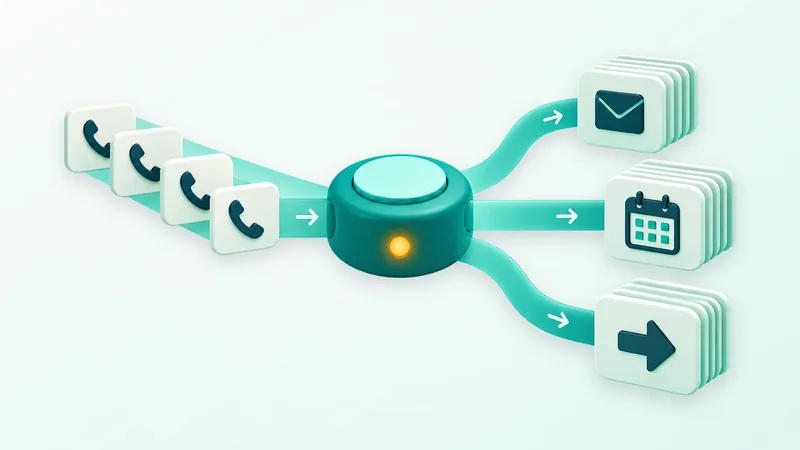
An AI voice agent is software that talks on the phone for a business. It listens, works out what the caller needs, replies in a natural voice and takes actions such as booking a slot or transferring the call. It can answer inbound calls or place outbound ones, built by you or run by a managed service.
Key takeaways
- An AI voice agent chains speech recognition, a language model, written instructions, connected tools and a synthetic voice into one conversation loop.
- Inbound agents answer, route and book; outbound agents work through your own contact lists for reminders, confirmations and follow-ups.
- The instructions and business information behind an agent shape call quality more than the choice of underlying model.
- Developer platforms give engineers control, while managed services trade some of that control for a team that builds, tests and maintains the agent.
- Judge any AI phone agent by calling it yourself and trying to break it: interrupt, mumble a name, go off-script and ask for a person.
An AI voice agent is software that holds a phone conversation on behalf of a business. It picks up or dials out, works out what the person on the line wants, answers in a natural voice and gets something done: a booked appointment, a qualified lead, a message routed to the right person.
This guide explains how AI phone agents work, the inbound and outbound jobs they take on, the kinds of products on the market, where they fall short and how to judge one before you let it speak to your customers.
What is an AI voice agent?
An AI voice agent is a program that understands spoken language and answers out loud in real time, usually over a phone line, while following rules a business has written for it. It differs from a recorded menu because callers talk in their own words, and from a chatbot because the whole exchange happens by voice at the pace of a normal call.
AI phone agent and AI calling agent usually mean the same thing. An AI receptionist is a voice agent with one particular job: answering a company's incoming calls the way a front desk would.
How does an AI voice agent work?
An AI voice agent runs a loop that repeats each time someone speaks: the call audio is transcribed into text, a language model reads it next to the agent's instructions and decides what to say or do, any action runs through a connected tool, and a synthetic voice speaks the reply. Well-built systems keep that loop short enough to feel like a natural pause.
The phone connection
Calls reach the agent through telephony: a number, a carrier or a business phone system that passes the audio to the software. That is why most businesses keep their current number and forward calls to the agent, a setup we walk through in our guide to keeping your business number.
Listening: speech recognition
Speech-to-text turns the caller's words into a running transcript, coping with accents, background noise and the details a business cares about most: surnames, street addresses and callback numbers. Careful agents read those back, so a misheard digit is caught on the call rather than the next morning.
Thinking: the language model and its instructions
A large language model reads the transcript and chooses the next move. On its own it knows nothing about your company; what makes it useful is the material it gets: its role, your services, hours and policies, and the moments it should hand over. That guidance is usually called the prompt, and our article on designing prompts for voice agents shows how to write one.
Acting: tools and integrations
An agent becomes useful when it can act: hold a calendar slot, update a CRM record, text a confirmation or pass the call to a colleague. Each action is a tool it is permitted to use, and its instructions say when.
Speaking: text-to-speech and turn-taking
A synthetic voice reads each reply aloud, but timing matters more than the voice. The agent has to notice when the caller has finished, stop the instant it is interrupted and avoid dead air while a tool runs. Callers forgive a slightly artificial voice far sooner than one that talks over them.
Inbound and outbound: the two jobs of an AI phone agent
Inbound agents answer the calls customers place to you; outbound agents call people on a list you supply. The technology is the same, but the goals, scripts and rules differ.
Inbound calls
Most small businesses start here, because the pain is obvious: the phone rings while the team is busy, closed or on another call. An inbound agent greets the caller, answers routine questions, books or moves appointments, takes a detailed message and sends anything it shouldn't handle to a person.
Outbound calls
Outbound agents ring people who already know you: appointment reminders, confirmations, follow-ups after a quote, check-ins after a job, or callbacks to someone who filled in a web form. Outbound calling carries consent and telemarketing rules that inbound does not, so read our guide to AI outbound calling before planning a campaign.
What can AI voice agents do for a business?
AI voice agents handle conversations with a recognizable shape, which for many businesses describes most phone traffic. Typical jobs look like this:
| Job | What the caller says | What the agent does | When a person steps in |
|---|---|---|---|
| Answer questions | "Are you open Saturday, and do you take walk-ins?" | Answers from the business's own information | The answer isn't in its material |
| Book appointments | "Can I come in Thursday afternoon?" | Checks the calendar, offers times, books the slot and texts a confirmation | The request breaks a booking rule |
| Qualify leads | "I need a quote for a new roof." | Asks your screening questions, records the answers, then books or routes | A promising lead wants to talk now |
| Route calls | "I have a question about my bill." | Transfers to the right person under your rules | Every time, by design |
| Reminders and follow-ups | Outbound: "Calling to confirm tomorrow at ten." | Confirms, reschedules or logs a cancellation | The person raises a complaint or an odd request |
Industry changes the details, not the pattern: a law firm wants consistent intake questions, a contractor wants urgent jobs flagged at once. An agent can also answer in Spanish, French, Hindi and many other languages, or detect the caller's language from their first words.
How is an AI voice agent different from an IVR or a chatbot?
An IVR phone tree makes callers press keys or say fixed words to move through a set menu, while an AI voice agent lets them explain the problem in their own words and responds to what they actually said. A chatbot does similar reasoning in text on a website. A voice agent must do it aloud, live, on a phone line.
A menu can route, but it cannot answer "Do you cover my street if I'm just past the county line?" A voice agent can, if someone gave it your service area. The price is predictability: a voice agent needs good instructions and regular review to stay on track.
Types of AI voice agent products
The technology inside these products is often similar. The real difference is who builds the agent and who keeps it in shape after launch.
| Developer platform (DIY) | Self-serve app | Managed service | |
|---|---|---|---|
| Who builds the agent | Your developers, through code and a builder | You, through settings and templates | The provider's team, with your input |
| Skills you need | APIs, telephony and prompt writing | Comfort configuring software | Knowledge of your business and your callers |
| Your time | Highest, before launch and after | Moderate; you tune it yourself | Lowest: a setup call and reviewing test calls |
| Flexibility | Very high | Limited to the options the app exposes | High within what the provider supports |
| Usually suits | Software teams, agencies, products with voice built in | Simple needs and owners who like to tinker | Busy owners who want it done properly without building it |
Developer platforms hand engineers the building blocks: voices, models, numbers and an API. They fit companies putting voice inside their own product or building agents for clients, and our comparison of AI voice agent platforms looks at them side by side.
Managed services sit at the opposite end, and Calldone is one of them. Our team learns your business on a short call, writes and trains the agent on your FAQs, chooses and tunes its voice, connects your calendar or CRM and tests the call flow with you before it answers anyone for real. No technical skills are needed on your side at any stage.
What are the limits of AI voice agents?
AI voice agents are weakest where a call depends on judgment, emotion or facts nobody gave them. They can sound sure while being wrong if their instructions leave gaps, they struggle on very noisy lines, and some callers simply want a human. Planning for that is part of building the agent, not a later fix.
- Missing information. If a price or policy isn't in its material, a well-instructed agent says it will check; a careless setup lets it guess.
- Hard conversations. Complaints, bereavement, disputes and anything that needs discretion belong with your team.
- Poor audio. Wind, traffic, speakerphones and weak signal raise the error rate on names and numbers.
- Outbound consent. Ringing people who never agreed to hear from you creates legal and reputational risk, whatever software places the call.
How do you evaluate an AI voice agent?
Evaluate an AI voice agent by calling it yourself several times and deliberately trying to confuse it. A vendor demo shows the smooth path; your own calls show what customers hear on a bad day. Try these, then check what each call recorded and changed in your systems:
- Interrupt it halfway through a sentence. It should stop, listen and respond to the new point.
- Give a surname, a street address and a phone number, then check the transcript for mistakes.
- Ask something that isn't in its information. It should admit that rather than invent an answer.
- Book a time, then change your mind and ask for a different day.
- Say "I'd like to speak to a person" and time how long the handoff takes.
- Call from a loud room or on speakerphone, then go quiet for several seconds and see how it recovers.
- Compare the summary and outcome it produced with what really happened.
Then ask who maintains the instructions, which calendars and CRMs it connects to, whether your call content trains anyone's models and how costs grow with minutes. With Calldone, each call lands in your dashboard with its recording, transcript, summary and outcome, and your content is never used to train AI models. Current plans are on our pricing page.
Should an AI voice agent say it is an AI?
Yes. An AI voice agent should be honest about what it is whenever a caller asks, and many businesses have it say so in the greeting. Pretending to be human tends to backfire the moment a caller notices, and it casts doubt on everything else the agent said. Recording-consent rules also differ between states, so check what applies where you operate.
Disclosure costs little. Callers often care more about an answer than about who gives it, and a plain line such as "I'm the automated assistant for the clinic, I can book you in or get someone from the team" sets expectations and offers an easy way out.
Getting a voice agent ready for real callers
Launching is mostly an information exercise. Before its first live call, an agent needs your services and hours, your booking rules, the questions people ask most, the situations that must reach a person and the tone you want. Then start narrow: pick one job, such as after-hours calls or appointment confirmations, read the first weeks of transcripts and widen its role from there.
An AI voice agent is a tool for a specific problem: conversations that are too frequent, too repetitive or too badly timed for people to handle well. Point it at that problem, give it honest limits and a clear route to your team, and it earns its place on your phone line.
Frequently asked questions
What is an AI voice agent used for?
Businesses use AI voice agents to answer incoming calls, book and reschedule appointments, answer common questions, qualify new leads, take messages and route callers to the right person. On the outbound side, they place reminder, confirmation and follow-up calls to people on a contact list. The common thread is conversations that repeat often enough to be described in advance.
Is an AI phone agent the same as an AI receptionist?
An AI receptionist is one kind of AI phone agent. The phone agent is the general technology for holding conversations by voice, whether the call comes in or goes out. A receptionist agent is set up specifically to answer a company's incoming calls, handle front-desk requests such as bookings and questions, and pass calls to staff when needed.
Can an AI voice agent make outbound calls?
Yes. Outbound voice agents call people on a list you provide for jobs like appointment reminders, confirmations, quote follow-ups and check-ins after a visit. During the call they can confirm, reschedule or log a cancellation. Only call people who have agreed to hear from you, and check the consent and telemarketing rules that apply where you and your contacts are.
How natural do AI voice agents sound?
Current synthetic voices sound close to a person on a phone line, and some callers never ask. Timing usually gives an agent away before the voice does: long pauses, talking over the caller or answering in paragraphs. Short replies, graceful interruptions and a voice suited to the business matter more than a polished voice.
Do I need technical skills to use an AI voice agent?
It depends on the product. Developer platforms expect someone comfortable with APIs, telephony and prompt writing, and self-serve apps need patience with settings. A managed service such as Calldone needs none: the team builds, trains and tests the agent with you, connects your calendar or CRM, and helps you forward your existing number.
How much does an AI voice agent cost?
Cost depends on the type of product. Developer platforms often bill by usage, plus the engineering time to build and maintain the agent. Managed services typically charge a monthly plan that includes conversation minutes and setup. Calldone plans include a pool of minutes shared by inbound, outbound and website conversations; current plans are on the Calldone pricing page.
The Calldone Team
Editorial team
Calldone builds, deploys and manages AI voice agents that answer business calls, book appointments and qualify leads. We write about what we see running phone lines for small businesses.