The short answer
An after hours answering service picks up when your office is closed and decides what each call needs. Routine callers get answers, a booked slot for the next day or a detailed message. Genuine emergencies reach your on-call person right away. How well it works depends on the rules you write for what counts as urgent.
Key takeaways
- Good after-hours coverage triages: it separates real emergencies from calls that can wait until morning.
- Define urgent in plain words with examples, such as "water is actively leaking," before any service goes live.
- Routine night calls should end with something done, like a booked appointment or a complete message, rather than a vague promise of a callback.
- Escalation needs a named on-call person and a rule for what happens when nobody picks up the transfer.
- AI and human 24/7 answering services both work; the choice turns on volume, emergency risk and how much judgment night calls need.
An after hours answering service answers your phone once the office closes, so the 9 p.m. caller with water coming through the ceiling and the Sunday caller who just wants to move Tuesday's appointment both reach something better than a voicemail beep. What separates useful after-hours coverage from a message machine is triage: knowing which calls can wait and which can't.
This guide covers what night and weekend coverage should actually do, how to write the rules it follows, how escalation to an on-call person works, and how AI and human 24/7 answering services compare once the lights are off.
What does an after hours answering service do?
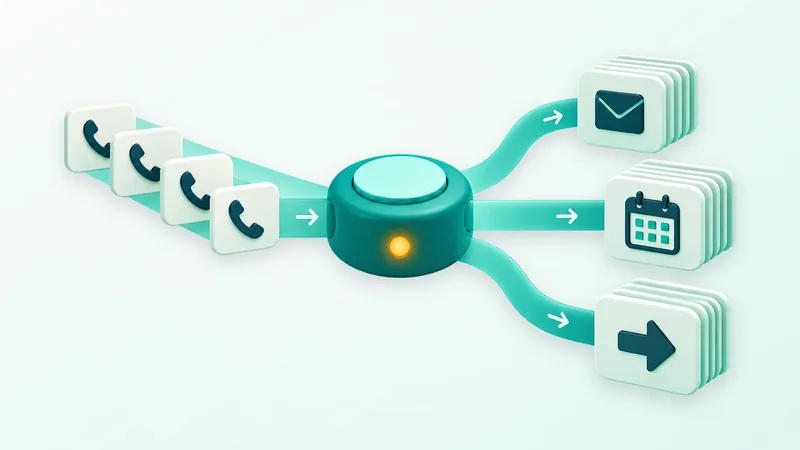
An after hours answering service answers calls outside your business hours and handles each one by rules you set: answering common questions, booking the next open slot, taking a full message, or putting a genuine emergency through to whoever is on call. The aim is that every caller leaves with a next step and you start the morning with an organized list, not a full mailbox.
That last part matters more than it sounds. A voicemail box hands you a stack of recordings to play back, some of them missing a callback number. A good after-hours service hands you each caller's name, number, reason and urgency, with the routine requests already booked.
Triage: telling urgent calls from routine ones
Every after-hours call lands in one of three buckets: it needs someone now, it needs someone tomorrow, or it can be resolved on the spot. The examples below come from a few trades and offices; your own list will differ.
| Caller says | Bucket | What should happen |
|---|---|---|
| "Water is coming through my kitchen ceiling." | Urgent | Collect the address and callback number, then transfer to the on-call plumber |
| "Our furnace quit and it's below freezing tonight." | Urgent, by your rule | Transfer to on-call, or book the first morning slot if your policy says so |
| "I'd like a quote for a new water heater next week." | Routine | Book an estimate visit and text a confirmation |
| "I need to move tomorrow's 10 a.m." | Routine | Find a new time in the calendar and confirm it |
| "What time do you open Saturday?" | Resolved now | Answer from your hours |
| "I was overcharged on my last invoice." | Routine, but sensitive | Take a detailed message and flag it for the manager in the morning |
| "I'm locked out of my unit." | Depends on your policy | Follow the written rule: transfer, give a lockout number or book |
The clear cases are easy. The work is in the middle rows, where two businesses in the same trade make different calls. Decide them in advance, not at 2 a.m. Heating and cooling companies will find trade-specific rules in our HVAC answering service guide, and plumbers in the plumbing answering service guide.
How do you set after-hours rules?
Set after-hours rules by writing down, in plain language, what counts as an emergency for your business, who gets those calls, what happens if they don't pick up, and what every other call should end with. Use concrete examples instead of categories: "water is actively leaking" is clearer to any answering service, human or AI, than "plumbing emergency."
- 1
Define urgent with examples
List the situations that justify waking someone up, and a few that sound urgent but aren't. A dripping tap at midnight can wait; a burst pipe can't.
- 2
Name the on-call chain
Say who takes urgent calls, on which number, and who is next if they don't pick up. Keep the rotation somewhere the service can follow it.
- 3
Decide what routine calls end with
Booking the next available slot beats a message. Where booking isn't possible, list exactly which details the message must include.
- 4
Limit what can be promised
Spell out what callers can be told about response times. Never let the service promise an arrival time your team can't keep.
- 5
Choose how messages reach you
Decide who reads overnight messages first in the morning and where they will find them. Calldone keeps every message in its dashboard; when comparing other services, ask whether they also send messages by text or email.
- 6
Set the schedule
Decide when after-hours starts and ends, and list your holidays. Forwarding can follow that schedule or stay on all the time.
- 7
Test before going live
Call in pretending to have each kind of emergency and each kind of routine request, and check what happens every time.
Escalating emergencies to your on-call person
When a call qualifies as urgent, the order of events matters. The service should first collect the caller's name, callback number and location, so nothing is lost if the transfer drops. Then it transfers the call to your on-call number. If nobody answers there, it follows your fallback rule: a message marked urgent or a scheduled callback, so the caller still leaves with a next step.
It also needs to know its limits. For anything involving danger to life, such as a gas smell, a fire or a medical crisis, the instruction should be to tell the caller to get to safety and call 911 before anything else. Write that rule in plainly, whoever answers your phones.
With Calldone, the escalation rules are yours to set: the agent transfers the caller to your on-call number or a live team member, and if nobody answers, it takes an urgent message or schedules a callback, with the routing confirmed during setup. It can text the caller a confirmation of what happens next, and the summary waits in your dashboard.
What you should find in the morning
The real test of an after-hours service is the first ten minutes of your morning. You should be able to see at a glance:
- Which urgent calls came in, who handled them and how each one ended.
- Which appointments were booked or moved overnight, already in your calendar.
- Every message, with name, callback number, address where relevant and the reason for the call.
- A recording and transcript for any call you want to check.
Calldone returns a recording, a full transcript, a summary and the outcome for every call in its dashboard, and appointments the agent books land in your Google Calendar or CRM. If overnight booking is the main job you want done, our guide to the AI appointment setter goes deeper on scheduling rules.
AI or human after-hours answering?
Both can run a good night line. The difference is where each one is strong.
- AI answering service. Picks up on the first ring at any hour, books straight into your calendar, applies the same rules on every call and records everything. It's weaker on unusual situations and frightened callers, and it's only as good as the rules it was given.
- Human after-hours service. Brings judgment to odd situations and a human voice to scared callers. Operators often take messages rather than book, cover many clients at once, and the cost tracks the minutes they spend.
As a rule of thumb, lots of routine night calls with a few clear emergencies suit AI. A small number of high-stakes calls, or calls that need a trained person to assess risk, suit humans. Many businesses use AI for the bulk of calls with a fast transfer path to a person for the rest. For how the AI side works under the hood, see what an AI voice agent is.
Do you need 24/7 coverage or just after hours?
Most small businesses need after-hours coverage at minimum: nights, weekends and holidays. A 24/7 answering service goes further and also answers during the day, catching calls when your team is busy, at lunch or already on another line. If your call log shows daytime misses as well, set it up to answer around the clock.
Switching between the two is a forwarding change. You can forward your line only outside business hours, only when nobody picks up, or all the time. Most businesses keep their existing number and adjust the forwarding, which our guide to keeping your business number explains. If daytime calls are the bigger problem, our guide to choosing an answering service for small business compares your options.
Nights and weekends are when your phone has the least help and callers have the least patience. Write the rules, test them with pretend emergencies and read the first week of calls. After that, a closed sign on the door no longer means a closed phone line.
Frequently asked questions
How does an after hours answering service know a call is an emergency?
It follows the definition you give it. You list the situations that count as urgent, ideally with plain examples such as an active leak or no heat in freezing weather, plus a few that don't qualify. The service, human or AI, asks questions to match the caller's problem against that list, then routes urgent calls to your on-call person.
Can an after-hours answering service book appointments?
Yes, if it has access to your calendar. An AI after-hours service connected to your calendar can offer the next open slots, book one while the caller is on the line and text a confirmation. Human services often take the request as a message for your office to confirm in the morning, which leaves the caller without a confirmed time overnight.
What is the difference between an after hours answering service and a 24/7 answering service?
An after hours answering service covers only the times your business is closed, such as evenings, weekends and holidays. A 24/7 answering service answers around the clock, including business hours, so it also catches overflow when staff are busy or on another line. Many providers offer both and let you switch between them by changing your call forwarding.
Can I turn after-hours answering on only when we close?
Yes. You can forward your business line to the answering service on a schedule, switch forwarding on by hand when you lock up, or forward only the calls nobody picks up. Most phone systems and carriers support these options. You keep the same number throughout, so callers notice no change except that someone always answers.
What should happen if the on-call person doesn't answer?
Your rules should say. A common setup is to transfer to the on-call number and, if nobody answers, take a message marked urgent or schedule a callback, with the summary waiting in the dashboard. With Calldone, that routing is confirmed during setup. Give the service a clear instruction for each step, so a missed transfer never leaves a caller cut off without a next step.
Is an AI after-hours answering service safe for emergencies?
An AI service should route emergencies, not resolve them. Set it up to recognize urgent calls from your list, collect the caller's details first and transfer to your on-call person. For any danger to life, its instruction should be to tell the caller to call 911 immediately. Calls that need a trained person to assess risk belong with a staffed service.
The Calldone Team
Editorial team
Calldone builds, deploys and manages AI voice agents that answer business calls, book appointments and qualify leads. We write about what we see running phone lines for small businesses.