The short answer
An AI answering service answers your business calls with a voice agent instead of human operators. It talks with callers in plain language, answers from your own information, books appointments, takes messages and transfers calls that need a person. Judge one by calling it yourself, testing the handoffs and reading the records it produces.
Key takeaways
- A traditional answering service mostly relays messages, while an AI answering service can finish the job on the call, such as booking or rescheduling.
- An AI phone answering service and an AI answering service are the same product under two names.
- What callers hear depends on setup: the facts, rules and handoff paths someone writes for the agent.
- Test with live calls that include interruptions, off-script questions and a request for a real person.
- Keep people in the loop for complaints, emergencies and any call that turns on a judgment.
An AI answering service is a phone service where a voice agent, not a human operator, picks up your business calls. It listens to the caller, replies in a natural voice and acts on what they want. If you've used a traditional answering service that reads from a script and emails you a message slip, the difference shows up in what happens after hello.
Below you'll find a plain definition, one real-world call followed from first ring to the summary in your dashboard, how the AI version compares with the operator model, and a test plan for judging providers.
What is an AI answering service?
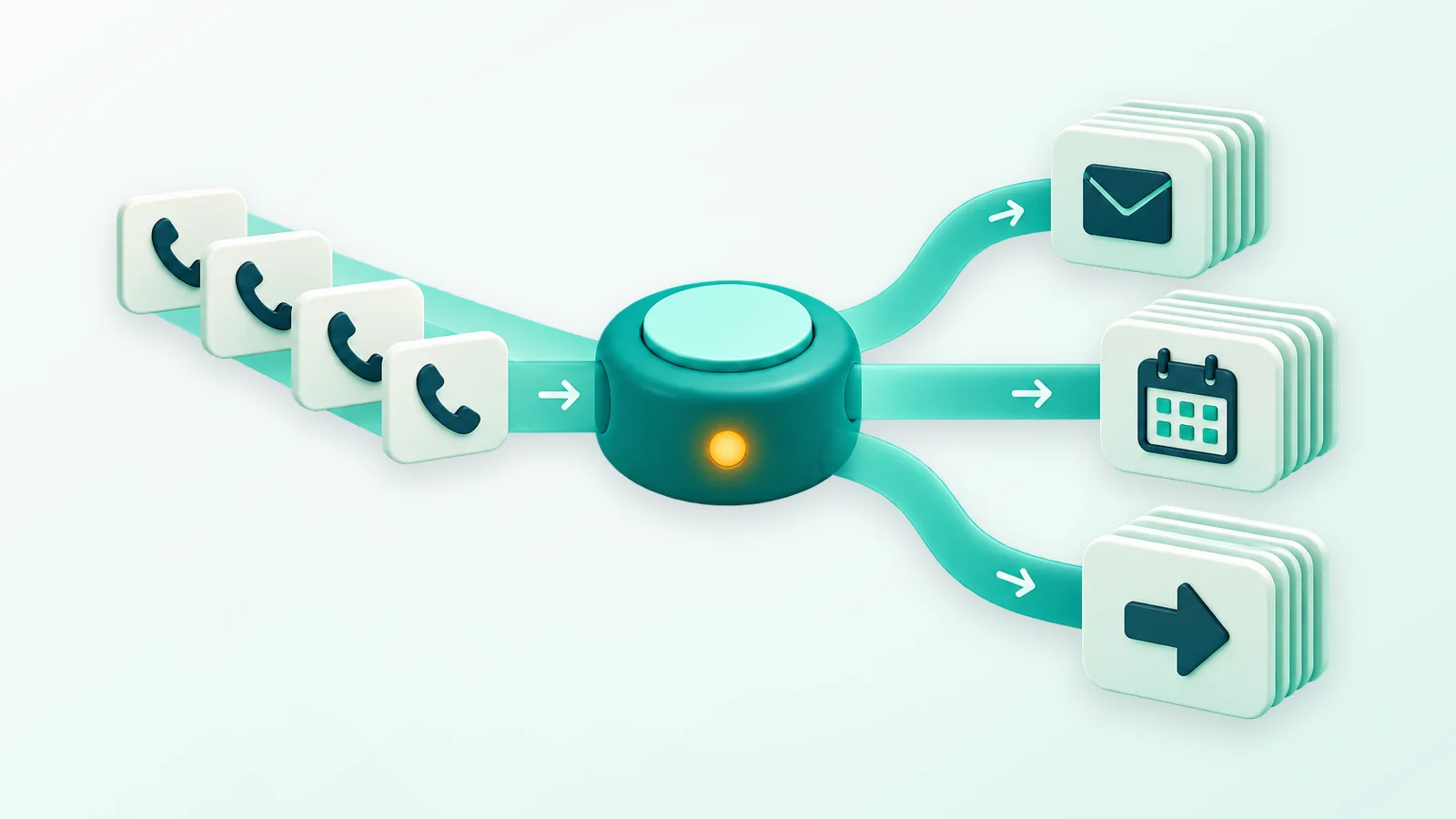
An AI answering service is a hosted voice agent that answers inbound calls for your business at any hour. It turns speech into text, decides what to say using a language model guided by your instructions, and speaks back in a synthetic voice. It can also act: check a calendar, book a slot, send a text or put the caller through to your team.
You'll also see it sold as an AI phone answering service; the two names describe the same product. Other vendors call it an AI receptionist, which our AI receptionist guide covers in depth, and the technology underneath is explained in what an AI voice agent is. The label matters less than what the agent can actually do on your calls.
What happens on a call, from first ring to summary
Descriptions only go so far. Here is one call to an independent auto repair shop at 6:40 on a weekday evening, after the front counter has closed.
- 1
The pickup
The agent answers on the first ring with the shop's own greeting. There is no menu to press through; the caller just starts talking.
- 2
The request
She explains that her check-engine light came on this morning and the car is idling rough. The agent asks for the make, model and year, and whether the light is steady or flashing, because the shop told it a flashing light means the car shouldn't be driven far.
- 3
The questions
She asks what a diagnostic costs and whether she can wait while it's done. The agent answers from the shop's own price list and waiting-room policy, worded the way the owner approved.
- 4
The booking
It checks the shop's calendar, offers 8 a.m. or 1 p.m. on Thursday, and books 8 a.m. when she picks it. It reads back her name and mobile number to confirm them.
- 5
The text
Before hanging up, it texts her a confirmation with the shop's address and drop-off instructions.
- 6
The handoff that didn't happen
Had she said the car had broken down on the highway, the shop's rules say to transfer her to the owner's tow line. She didn't, so nobody was disturbed.
- 7
The record
The owner sees the call the next morning: the recording, the transcript, a short summary and the outcome, booked.
Under the operator model, the same call often ends with a name, a number and a promised callback in the morning. By then she may already have phoned the dealership.
How is an AI answering service different from a traditional one?
A traditional answering service uses human operators, usually shared across many client businesses, who follow a script, take a message and pass it on. An AI answering service uses software trained on your business that can hold the whole conversation and complete the task. Operators bring human judgment; the AI version brings availability, consistency and the ability to act inside your tools.
| Traditional answering service | AI answering service | |
|---|---|---|
| Who answers | Operators working from your script | A voice agent configured for your business |
| How a call usually ends | A message for you to return | An answer, a booking, a transfer or a message |
| Knowledge of your business | Whatever fits in the script and notes | Your services, prices, policies and FAQs |
| Busy moments | Depends on how many operators are free | Not tied to operator headcount; ask about call capacity |
| What you receive | A message log | Recording, transcript, summary and outcome per call |
| Strongest on | Unusual, emotional or delicate calls | Repeat questions, bookings and night calls |
Many businesses don't pick one exclusively. Our full comparison of AI receptionists and answering services goes through cost, call quality and the hybrid setups that use both.
Calls it handles well, and calls that need a person
AI answering works best where calls repeat. Typical good fits:
- Hours, location, parking, service area and "do you do X" questions.
- New appointments, reschedules and cancellations against a live calendar.
- Intake for new leads: what they need, where, how soon and how to reach them.
- Detailed messages for a named person, with the details read back to the caller.
- Night, weekend and holiday calls that would otherwise reach voicemail.
It is weaker when a call turns on judgment or emotion. A caller who is upset about a bill, describing something nobody planned for, or negotiating a price needs one of your people. A good setup spots those calls early and hands them over rather than trying to talk its way through.
How much does an AI answering service cost?
Most AI answering services charge a monthly plan with a set amount of conversation time included and a per-minute rate beyond it, though some bill per call. Because software rather than staff time does the answering, the cost structure differs from an operator service. Setup fees, number fees and contract length change the real total, so compare the whole bill.
Our guide to AI receptionist cost goes through each pricing model and the questions to ask. Calldone's live plans are on the pricing page; each one includes at least one agent and the full done-for-you setup.
How do you evaluate an AI answering service?
Evaluate an AI answering service by calling it, not by reading about it. Ask for a demo line or a test agent built on your own information, then place a set of deliberately awkward calls and read what the provider's system recorded afterward. Twenty minutes of testing tells you more than any feature grid.
- The easy one. Ask about hours and location. Listen for speed, tone and whether it sounds like a business or a machine.
- The change of mind. Book an appointment, then switch halfway and ask for a different day.
- The interruption. Cut in while it's talking. A good agent stops and listens instead of finishing its sentence.
- The unknown. Ask something it was never told. It should offer to find out, not invent an answer.
- The human request. Say you want to talk to a real person. It should transfer or take a message without arguing.
- The bad line. Call from a car or a noisy room and give a phone number. Check it reads the number back correctly.
- The paper trail. Open the dashboard and look at what arrived: recording, transcript, summary and outcome.
Then put a few direct questions to the provider. Who writes and tests the agent's instructions? Is your call data used to train their models? Which calendars and CRMs does it connect to? What happens in a month when you use more minutes than planned? Can you cancel without a fee?
For reference, Calldone's answers: our team writes and tests the agent with you; your content isn't used to train AI models; we connect Google Calendar and CRMs such as GoHighLevel and Clio, with custom actions and signed webhooks for other systems; extra time bills at your plan's overage rate rather than cutting callers off; and there are no cancellation fees.
What does an AI answering service need from you?
It needs what a new hire would need on day one, written down: your services, hours, the prices you're willing to quote, booking rules, the questions callers ask most and exactly when to involve a person. The better that material, the better the calls.
- A greeting that sounds like your business, not a call center.
- What you do and don't do, so it can redirect the wrong callers kindly.
- Booking rules: appointment lengths, buffers and who takes which job type.
- Escalation rules: which calls transfer, to which number, and what to do if nobody answers.
- Where messages go: who follows up and what details they need. Calldone keeps each message in the dashboard; ask any provider whether it also forwards messages by text or email.
Connecting the phone line is the smaller job. Most businesses forward their existing number to the agent; our guide to keeping your business number explains how that forwarding works.
An AI answering service is worth a look if your phone rings when nobody can answer and most of those calls follow a pattern. Test it hard, write clear handoff rules and read the first few weeks of transcripts. If nights are your main gap, our after-hours answering guide covers the rules that matter there.
Frequently asked questions
Is an AI phone answering service the same as an AI receptionist?
In practice, yes. Both describe a voice agent that answers business calls, handles questions, books appointments and routes callers who need a person. Vendors pick the label that suits their buyers: "answering service" appeals to people replacing an operator service, "receptionist" to people replacing or supporting a front desk. Compare what the agent actually does on a call rather than the name.
Can an AI answering service take messages?
Yes. Taking a message is the simplest thing it does. A good one asks for the caller's name, number and reason, reads the key details back to confirm them, and records the message with a summary in your dashboard for the right person to act on. Ask any provider whether it can also forward messages by text or email. Unlike a voicemail greeting, it asks the caller for every detail you need.
Does an AI answering service work nights, weekends and holidays?
Yes. Software doesn't keep office hours, so the agent answers on the first ring at 3 a.m. on a holiday the same way it does on a Tuesday afternoon. What changes after hours is the rules: you might have it book next-day appointments, take messages for routine calls and transfer only true emergencies to whoever is on call.
What happens if the AI misunderstands a caller?
A well-built agent reduces mistakes by confirming names, numbers and dates back to the caller before acting. When it still can't work out what someone needs, it should say so and take a message or transfer the call rather than guess. Because every call is recorded and transcribed, you can spot misunderstandings and get the instructions corrected.
Can an AI answering service handle calls in Spanish?
Many can. Every Calldone agent has a language setting that isn't limited by plan: pin it to one language, such as English or Spanish, or set it to auto-detect, so it picks up the caller's language from their first words and replies in it. Voice quality varies by language, so test the voices in the languages your callers speak.
Is my call data used to train the AI?
It depends on the provider, so ask before you sign. Calldone doesn't use customer content to train AI models or for any other customer's benefit, encrypts data in transit and at rest, and keeps recordings and transcripts under your control. Other providers set their own policies, which you'll usually find in their terms of service or privacy policy.
The Calldone Team
Editorial team
Calldone builds, deploys and manages AI voice agents that answer business calls, book appointments and qualify leads. We write about what we see running phone lines for small businesses.