The short answer
The right answering service for small business depends on your calls. Short, repeatable calls suit an AI service that answers and books at any hour. Sensitive or complex calls suit live operators. Many owners combine the two. Before choosing, sort two weeks of calls by type and ask each provider exactly how calls come back to you.
Key takeaways
- A small business has four realistic routes: answer in-house, a live call answering service, a virtual receptionist team or an AI agent.
- Live human services remain the better fit when most calls need empathy, negotiation or careful judgment.
- AI services fit when most calls are routine and arrive at all hours, because they can finish bookings instead of relaying messages.
- Questions about handoffs, call records, billing and contract terms reveal more than a provider's feature list.
- Whatever you choose, keep a written rule for which calls must reach you directly.
An answering service for small business picks up the phone when you and your team can't, so callers reach a helpful voice instead of a voicemail greeting. Finding one isn't hard. Picking the right type is. A call answering service staffed by people, a remote virtual receptionist, an AI agent and simply answering it yourselves each suit some businesses and frustrate others.
This guide explains how each option works, who it suits, how to match one to your own call mix and the questions to put to any provider before you sign. We sell the AI option, so we've tried to be plain about where the others win.
What does a call answering service do?
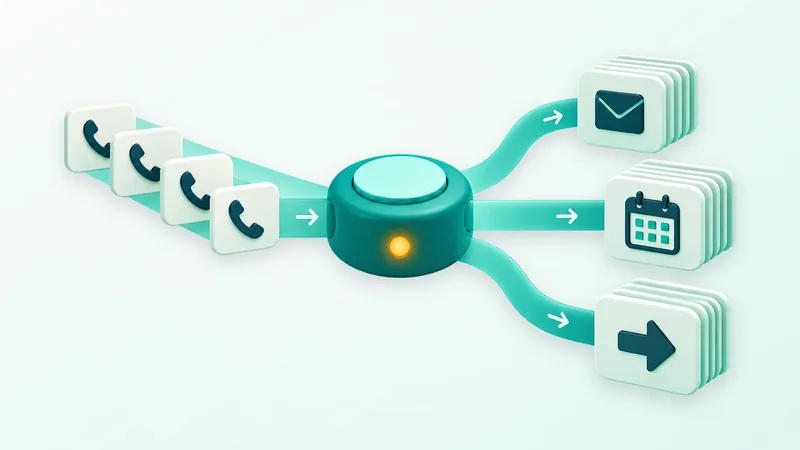
A call answering service answers your business line on your behalf, with your greeting, and handles each caller by your instructions: taking a message, answering basic questions, booking an appointment or putting urgent calls through to you. Services differ in who answers, how much they can do while the caller is on the line, and how they bill for it.
The point is continuity. A homeowner asking a roofer for a quote, a parent trying to book a tutoring session, a tenant reporting a broken lock: none of them wants a beep. Some leave a message; others simply try the next business on their list. An answering service keeps that first conversation with you.
Your four options, side by side
| Option | Who answers | How calls usually end | Fits | Trade-offs |
|---|---|---|---|---|
| Answer in-house | You or your staff | However your team handles them | Low call volume, high-touch work | Calls get missed during jobs, meetings and after closing |
| Live answering service | Shared human operators following your script | A message, sometimes a booking | Message-taking, and callers who expect a person | Limited to the script; billing tied to operator time |
| Virtual receptionist | A remote receptionist team working in your name | Transfers, bookings and messages | Professional firms where tone and nuance matter | Higher cost per call; often focused on business hours |
| AI answering service | A voice agent trained on your business | An answer, a booking, a transfer or a message | Repeat questions, bookings, nights and busy spells | Needs careful setup and clear handoff rules |
The lines blur in practice, and plenty of businesses combine options. For a closer look at the human front-desk route against AI, read virtual receptionist vs AI receptionist. For what the AI version does on a live call, see our guide to the AI answering service.
When a live answering service is the better choice
A human service earns its higher cost per call when your calls need a person more often than not. That's true for more businesses than AI vendors like to admit.
- Distressed callers. Funeral homes, legal intake after an accident and insurance claims calls often need warmth and patience before any facts get collected.
- Negotiation on the phone. If callers routinely haggle, ask for exceptions or need a judgment about whether you'll take them on, a person handles that better.
- Customers who insist on a person. Some client bases strongly prefer a human voice, and losing their trust costs more than the service does.
- A few long, delicate calls a week. Low volume with high stakes may be better served by a live receptionist than by building an agent around rare situations.
Many businesses split the work: a person during the day and AI at night, or AI on every call with a fast transfer to a human for the sensitive ones.
How do you choose an answering service for a small business?
Choose an answering service by matching it to the calls you actually get, not to a feature list. Spend two weeks sorting calls into routine, urgent and complex. If most are routine and many land when nobody's free, an AI service fits. If most need judgment, a live service fits. If it's an even mix, combine them.
- Log every call for two weeks: the time, who called, what they wanted and how it ended. A notepad by the phone is fine.
- Tag each one. Routine: hours, prices, booking, directions. Urgent: anything that can't wait until tomorrow. Complex: complaints, custom quotes, negotiations.
- Mark the misses. Circle the calls nobody answered and note the time of day.
- Read the pattern. Routine calls landing after hours point to AI. Complex calls during business hours point to a person. Urgent calls at night need an escalation rule, whoever answers.
- Write the job description. For each tag, decide what the service must do: answer, book, transfer or take a message.
That job description becomes your brief to providers, and it makes their quotes comparable because everyone is pricing the same work.
Questions to ask any call answering service
Ask every provider the same questions and get the answers in writing:
- Who exactly answers my calls, and how are they, or it, trained on my business?
- Show me what happens on a call you can't handle. Where does it go, and how fast?
- How do messages and bookings reach me: text, email, my calendar or my CRM?
- Can I hear a recording or read a transcript of every call?
- How is time billed: per minute or per call, rounded or exact, with or without hold time?
- What happens when several people call at once?
- Are nights, weekends, holidays or a second language extra?
- Can I keep my current phone number?
- What's the minimum term, and the notice period to cancel?
- Who owns the call data, and is it used to train anything?
For comparison, here is how Calldone answers a few of these. You keep your existing number by forwarding it to the agent. Every call comes back with a recording, a full transcript, a summary and its outcome. Customer content isn't used to train AI models. And you can cancel from the dashboard with no cancellation fee.
How much does a small business answering service cost?
Small business answering services usually charge per minute, per call or through a monthly plan with included time, and human services tend to price higher per call than AI because a person is on every one. The fees around the edges, such as setup, after-hours surcharges and minimum terms, often decide which is cheaper over a year.
Our guide to AI receptionist and answering service cost shows how to work out cost per handled call so you can compare quotes fairly. Calldone's current plans are on the pricing page.
Combining human and AI coverage
You don't have to pick one option forever. These combinations work well for small teams:
- Office by day, AI by night. Staff answer during business hours; calls forward to an AI agent at closing, on weekends and on holidays.
- AI first, people for the hard ones. The agent answers everything, handles routine requests and transfers complaints or high-value leads to your team.
- AI for overflow. When your receptionist is already on a call or at lunch, the next caller reaches the agent instead of voicemail.
If nights are your main gap, our guide to the after-hours answering service covers triage and on-call rules in more depth, and the AI receptionist guide explains how the agent itself works.
The best answering service for your business is the one that treats callers the way you would. Start from your call log, be honest about which calls need a person, and make every provider show you, on a real test call, what your customers will hear.
Frequently asked questions
Is an answering service worth it for a small business?
It's worth it when you regularly miss calls that carry new work, such as calls during jobs, meetings or after closing. Check two weeks of call logs: count the unanswered calls, estimate how many came from new customers and what a first job is worth. If that figure comfortably beats the monthly cost, an answering service is likely worth trying.
What is the difference between an answering service and a virtual receptionist?
An answering service traditionally uses shared operators who follow a script and mostly take messages. A virtual receptionist is a remote team that works more like your own front desk, transferring calls, booking appointments and handling more nuance, usually at a higher cost. An AI answering service is a third option, where a voice agent answers and can book or transfer by itself.
Can an answering service book appointments?
Many can, but how they do it varies. Some operators take the request and pass it to you to confirm. Virtual receptionists and AI services can usually book directly if they have access to your calendar. An AI agent connected to your calendar checks open times, books the slot while the caller is on the line and can text a confirmation.
Do answering services work 24/7?
Many live answering services offer around-the-clock coverage, sometimes at a higher rate for nights, weekends and holidays. Virtual receptionist teams more often focus on business hours, with after-hours options. AI answering services answer at any hour by default, since software doesn't work in shifts. Check what each quoted price actually covers before assuming it includes nights.
Can I use an answering service only when my line is busy or nobody picks up?
Yes. Most phone systems and carriers support conditional forwarding, which sends a call to the answering service only when your line is busy or rings out, or on a schedule such as after closing. Your team answers first, and the service catches the overflow. Ask your phone provider how to set it up on your existing number.
Will callers know I use an answering service?
Callers hear your business name and greeting, so many won't think about it. With a human service, some will notice the operator doesn't know details about their account. With an AI service, some will recognize an automated voice. Either way, what callers care about most is getting a helpful answer and a clear next step quickly.
The Calldone Team
Editorial team
Calldone builds, deploys and manages AI voice agents that answer business calls, book appointments and qualify leads. We write about what we see running phone lines for small businesses.